
One of the first questions buyers ask when sourcing custom drinkware is:
How much does a custom stainless steel tumbler cost?
The challenge is that there is no single meaningful price without first defining the product specification.
Two tumblers may look almost identical in a photo but have very different costs because of differences in stainless steel weight, lid construction, surface finish, logo process, packaging, quantity, tooling, and quality requirements.
For B2B buyers, the more useful question is therefore:
What affects the final custom stainless steel tumbler cost?
Understanding these factors makes it easier to compare quotations, control unnecessary costs, and avoid choosing a supplier based only on a unit price that may not reflect the same product specification.
This guide explains the main pricing factors from an OEM manufacturing and purchasing perspective.
Why There Is No Single Price for a Custom Tumbler
A custom tumbler is not one standardized product.
Before an accurate quotation can be prepared, a manufacturer normally needs to know:
- Product model
- Capacity
- Stainless steel specification
- Lid design
- Surface finish
- Color
- Logo method
- Order quantity
- Quantity per color
- Packaging
- Accessories
- Trade term
For example, a standard 20 oz tumbler using an existing lid, stock color, laser logo, and simple box has a very different cost structure from a 40 oz handled tumbler with a custom Pantone color, complex straw lid, full-color decoration, silicone accessories, and rigid gift packaging.
This is why quotations should only be compared after the specifications are aligned.
1. Product Size and Stainless Steel Weight
Capacity is one of the most obvious pricing factors.
A larger tumbler usually requires more stainless steel and may also require:
- A larger lid
- Larger plastic components
- A larger handle
- Larger packaging
- Fewer pieces per export carton
However, capacity alone does not determine cost.
Two 30 oz tumblers may still have different prices because of differences in:
- Stainless steel thickness
- Product weight
- Body shape
- Base construction
- Handle structure
- Number of components
For this reason, buyers should not assume that two products with the same capacity have the same manufacturing cost.
2. 304 vs 316 Stainless Steel
The stainless steel grade can also affect the price.
304 stainless steel is widely used for reusable drinkware and provides a strong balance between durability, corrosion resistance, manufacturability, and cost.
Some premium projects may specify:
316 stainless steel inner wall + 304 stainless steel outer wall
because the inner wall directly contacts the beverage.
316 generally has a higher raw material cost than 304, but the finished tumbler price difference cannot be calculated using one fixed percentage.
The actual impact depends on:
- Stainless steel weight
- Material thickness
- Which components use 316
- Product size
- Quantity
- Current raw material cost
If you are deciding between the two materials, see our guide:
304 vs 316 Stainless Steel for Water Bottles: Which Is Better?
3. Vacuum Structure and Product Complexity
A double-wall vacuum-insulated tumbler requires more manufacturing steps than a single-wall stainless steel cup.
Typical vacuum bottle production involves:
- Inner wall forming
- Outer wall forming
- Welding
- Vacuum processing
- Assembly
- Inspection
- Insulation testing
Product shape can add further complexity.
A simple straight tumbler is usually easier to manufacture than a model with:
- Large handle
- Decorative rings
- Complicated curves
- Multi-piece base
- Additional plastic components
- Special assembly requirements
A design change that appears small visually can sometimes require additional production steps, tooling, or inspection.
4. Lid Design Can Have a Major Cost Impact
The lid is often underestimated when buyers compare tumbler prices.
A simple PP lid may contain only a few components.
A more complex lid may include:
- PP or Tritan parts
- Straw
- Silicone seals
- Sliding mechanism
- Rotating mechanism
- Lock
- Handle
- Multiple injection-molded parts
Each additional component affects:
- Material cost
- Injection molding
- Assembly
- Quality control
- Production yield
The lid also plays a major role in the final customer experience.
Leak resistance, drinking comfort, straw performance, cleaning convenience, and opening mechanism all depend heavily on lid design.
So when two similar tumblers have noticeably different prices, the lid may be one of the main reasons.
5. Existing Components vs New Tooling
Using an existing bottle body and lid usually keeps development cost lower.
If the buyer requires a new lid, new shape, or completely new product structure, tooling may be necessary.
New product development can include:
- Engineering design
- Drawings
- Mold development
- Trial production
- Mold adjustment
- Functional testing
- Pre-production samples
It is important to separate:
One-time tooling cost
from:
Recurring unit cost
A mold is normally a development investment rather than simply part of the production price of every piece.
For smaller or first-time projects, using an existing mold is often the more economical starting point.
6. Surface Finish
The finish on the tumbler body can significantly affect the final quotation.
Common options include:
- Powder coating
- Spray painting
- Matte finishes
- Glossy finishes
- Metallic effects
- Pearl effects
- Gradient colors
- Other decorative finishes
A standard solid color is generally more straightforward than a complex decorative finish.
Cost can increase because of:
- Special coating materials
- Additional production steps
- More difficult color control
- Lower production efficiency
- Higher rejection rate
- Extra manual handling
For a detailed comparison, see:
Powder Coating vs Spray Painting for Stainless Steel Tumblers: Which Is Better?
7. Custom Color and Quantity per Color
Custom Pantone colors usually require more preparation than existing production colors.
That can include:
- Color development
- Sampling
- Approval
- Production setup
- Equipment cleaning
- Color changeover
The number of colors in an order also matters.
For example:
5,000 pieces in one color
is normally more production-efficient than:
5,000 pieces divided into ten colors
because every additional color may require another setup and cleaning cycle.
For pricing purposes, buyers should therefore provide both:
Total order quantity
and:
Quantity per color
8. Logo Method, Size and Printing Area
Logo cost is not simply a question of whether a tumbler has a logo.
Common branding methods include:
- Laser engraving
- Screen printing
- UV printing
- Heat transfer
- Full-wrap printing
- Other decorative processes
Pricing can change according to:
- Logo size
- Number of colors
- Number of logo positions
- Printing area
- Artwork complexity
- Production quantity
A small laser-engraved logo and a large full-color wraparound design do not have the same cost structure.
This is why buyers should make sure suppliers are quoting the same logo specification.
For more detail, see:
Best Logo Printing Methods for Custom Stainless Steel Tumblers
9. Order Quantity and MOQ
Order quantity has a major effect on unit price.
But larger orders are not cheaper simply because the manufacturer decides to offer a discount.
Larger quantities usually allow setup costs to be spread across more units.
These can include:
- Production setup
- Color setup
- Logo setup
- Packaging setup
- Material preparation
- Quality-control preparation
Production efficiency can also improve when larger quantities of the same specification are produced continuously.
However, MOQ and unit price are not exactly the same thing.
A project can have different MOQs for:
- Existing colors
- Custom Pantone colors
- Special models
- New tooling
- Printed packaging
- Custom inserts
- Accessories
The practical MOQ should therefore be confirmed for the complete finished product, not only the stainless steel body.
10. Packaging
Packaging can have a larger impact on the final cost than many buyers expect.
A simple white box or kraft box has a very different cost structure from a premium rigid gift box.
Packaging cost may include:
- Individual box
- Printing
- Insert
- Label
- Barcode
- Instruction card
- Sleeve
- Gift accessories
- Assembly
- Export carton
Premium packaging can also increase logistics cost.
A larger gift box may reduce pieces per carton and increase total CBM.
So its real impact may be:
Higher packaging cost + higher freight cost
For a detailed breakdown, see:
Custom Tumbler Packaging Options for Retail and E-commerce
11. Accessories
Accessories also add cost and complexity.
Common examples include:
- Straw
- Extra straw
- Cleaning brush
- Silicone boot
- Carrying strap
- Replacement lid
- Gift accessories
Each additional item can affect:
- Material cost
- Assembly
- Inspection
- Packaging
- Carton size
- Shipping weight
For multi-piece gift sets, these costs can become more significant than buyers initially expect.
12. Sampling and Product Development
Existing samples may require little preparation.
A custom sample can involve:
- Custom color
- Logo setup
- Special finish
- Packaging sample
- New component
- Prototype work
- Tooling
For this reason, sample cost should not always be compared directly with the final production unit price.
Some sample costs are related to one-time preparation rather than the normal cost of mass production.
13. Quality Requirements
Different buyers may have different quality standards.
Cost can be affected by requirements related to:
- Cosmetic inspection
- Color tolerance
- Leak testing
- Vacuum testing
- Material verification
- Packaging inspection
- Third-party inspection
- Customer-specific testing
Higher inspection requirements can increase production control and inspection time.
For large retail or branded programs, these requirements should ideally be defined before the final quotation is confirmed.
Why Two Factories Can Quote Very Different Prices
This is one of the most important questions in tumbler sourcing.
Two factories may both describe a product as:
- 304 stainless steel
- Double-wall vacuum insulated
- Powder coated
- Custom logo
- Individual packaging
Yet the prices may still be very different.
Possible reasons include:
| Cost Factor | Possible Difference |
|---|---|
| Stainless steel | Weight, thickness or material specification |
| Lid | Material, structure and number of components |
| Vacuum construction | Process and quality control |
| Coating | Material and finishing standard |
| Logo | Size, process and printing area |
| Packaging | Box material and structure |
| Accessories | Included or excluded |
| QC | Inspection requirements |
| Quantity | Different quantity assumptions |
| Trade term | EXW, FOB or DDP |
This is why a lower quotation is not automatically better.
A higher quotation is not automatically better either.
The important question is:
Are all suppliers quoting the same specification?
How to Compare Tumbler Quotations Properly
When comparing suppliers, buyers should align the following information:
- Product model
- Capacity
- Stainless steel grade
- Inner and outer wall specification
- Lid material
- Lid structure
- Surface finish
- Color
- Logo method
- Logo size
- Packaging
- Accessories
- Quantity
- Quantity per color
- Trade term
- Lead time
If these details are different, comparing only the unit price can be misleading.
A useful quotation should make it clear what is included.
EXW, FOB and DDP Also Affect the Price You See
Trade terms can make two quotations look very different.
EXW
EXW is based on the goods at the manufacturer’s facility, with the buyer handling subsequent transportation arrangements.
FOB
FOB normally includes the agreed export-related costs up to the named port according to the agreed terms.
DDP
DDP may include international freight, import-related costs and delivery to the destination, depending on the specific arrangement.
Therefore:
USD 3.20 EXW
and:
USD 4.40 DDP
cannot be compared as if they were the same product price.
Buyers should always confirm the Incoterm before comparing quotations.
Packaging and Shipping Can Change the Landed Cost
Product cost and landed cost are not the same thing.
Shipping can depend on:
- Destination
- Total weight
- CBM
- Carton quantity
- Freight method
- Packaging dimensions
- Customs requirements
This is why a very large premium gift box can increase the total project cost even if the tumbler itself remains unchanged.
For larger-volume B2B orders, carton dimensions and pieces per carton can become commercially important.
Custom Tumbler Cost Factors at a Glance
| Cost Factor | Typical Impact |
|---|---|
| Larger capacity | Usually higher |
| Higher stainless steel weight | Higher |
| 316 inner wall | Higher |
| Complex lid | Higher |
| Custom Pantone color | Higher at lower volume |
| Multiple colors | More production complexity |
| Simple laser logo | Relatively efficient |
| Large multi-color decoration | Higher |
| Standard box | Lower |
| Premium gift box | Higher |
| Existing mold | Lower development cost |
| New mold | Additional tooling cost |
| Larger quantity | Usually lower unit cost |
| More accessories | Higher |
| Higher QC requirements | Can increase cost |
These are general pricing directions rather than fixed rules.
Which Factors Usually Matter Most?
For many custom tumbler projects, the biggest pricing differences usually come from a combination of:
Product structure + lid + quantity + finish + logo + packaging
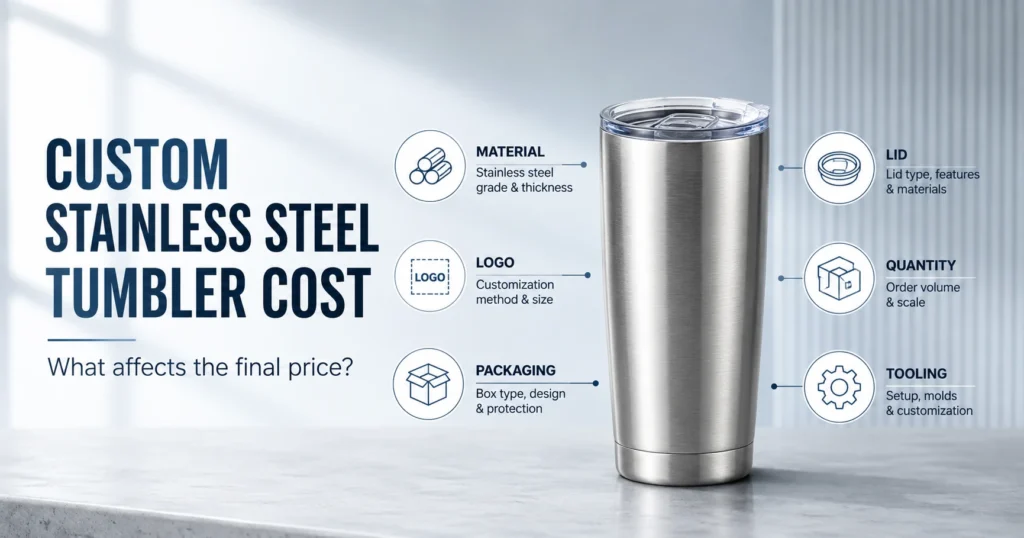
Buyers sometimes focus heavily on a small material-price difference while overlooking a complex lid or oversized gift box that may have a larger impact on the overall project.
For this reason, the complete product specification should be evaluated as one system.
Should You Always Choose the Lowest Quotation?
Not necessarily.
A low quotation may be perfectly suitable if it matches the required specification and quality level.
But before choosing it, confirm:
- Is the stainless steel specification the same?
- Is the steel weight comparable?
- Is the lid construction the same?
- Is the coating specification the same?
- Is the logo size the same?
- Is packaging included?
- Are accessories included?
- Is the Incoterm the same?
- Are the quality requirements the same?
Once these items are aligned, the unit price becomes much more meaningful.
How to Reduce Cost Without Sacrificing the Product Concept
Cost optimization does not always mean reducing quality.
In many projects, cost can be controlled by simplifying specifications that add little value to the final customer.
Possible approaches include:
- Use an existing bottle mold
- Use an existing lid
- Reduce unnecessary color variations
- Increase quantity per color
- Use a simpler logo process
- Use standard packaging for smaller orders
- Avoid oversized gift boxes
- Remove unnecessary accessories
The best approach is to protect the features customers actually value and simplify the ones they do not.
What Information Is Needed for an Accurate Quotation?
For a more accurate custom tumbler quotation, provide as much of the following information as possible:
- Product model or reference
- Capacity
- Order quantity
- Quantity per color
- Required colors
- Logo artwork
- Logo method if already known
- Packaging requirement
- Accessories
- Stainless steel specification if required
- Preferred trade term
- Delivery destination if freight quotation is required
If some details are still undecided, the manufacturer can usually help compare practical options.
But the more complete the specification is, the more accurate and comparable the quotation becomes.
FAQ
How Much Does a Custom Stainless Steel Tumbler Cost?
There is no single reliable price without defining the specification. Capacity, stainless steel weight, lid design, finish, logo, quantity, packaging, accessories, tooling, quality requirements and trade terms can all affect the final quotation.
Why Are Tumbler Prices Different Between Factories?
Different suppliers may use different steel weights, lid structures, coating materials, packaging, quality standards or trade terms. Quotations should be compared using the same specification.
Does a Larger Order Reduce the Unit Price?
Usually, larger quantities improve production efficiency and allow setup costs to be distributed across more pieces. The exact difference depends on the product and specification.
Is 316 Stainless Steel More Expensive Than 304?
Generally, yes. However, the finished tumbler price difference depends on the stainless steel weight and which components use 316. There is no universal fixed percentage.
Does Custom Packaging Affect Tumbler Cost?
Yes. Printed boxes, inserts, gift packaging, labels and assembly can increase the unit cost. Larger packaging can also increase shipping volume.
Does a Custom Lid Require New Tooling?
If a completely new lid structure is required, new tooling may be necessary. Using an existing compatible lid usually reduces development cost and lead time.
What Is the Best Way to Get an Accurate Quotation?
Provide the product model, capacity, quantity, colors, logo artwork, packaging requirements, accessories and preferred trade term. This allows the manufacturer to quote the actual project rather than a generic product.
Final Thoughts
The custom stainless steel tumbler cost is determined by the complete specification rather than one single factor.
Material is important, but so are product structure, stainless steel weight, lid design, surface finish, logo, quantity, packaging, accessories, tooling, quality requirements and trade terms.
This is why the best supplier comparison is based on equivalent specifications.
The goal for a B2B buyer should not simply be to find the lowest number.
It should be to find the right balance between:
Product quality + functionality + brand positioning + quantity + total project cost
At Warmus, we support OEM and ODM stainless steel drinkware projects with different product structures, materials, colors, surface finishes, logo methods, packaging options and development requirements.
If you need an accurate quotation for a custom stainless steel tumbler project, you can send us your product reference, capacity, quantity, color, logo artwork, packaging requirements and preferred trade term.
Our team can evaluate the complete specification and provide a quotation based on the actual project requirements rather than a generic price range.