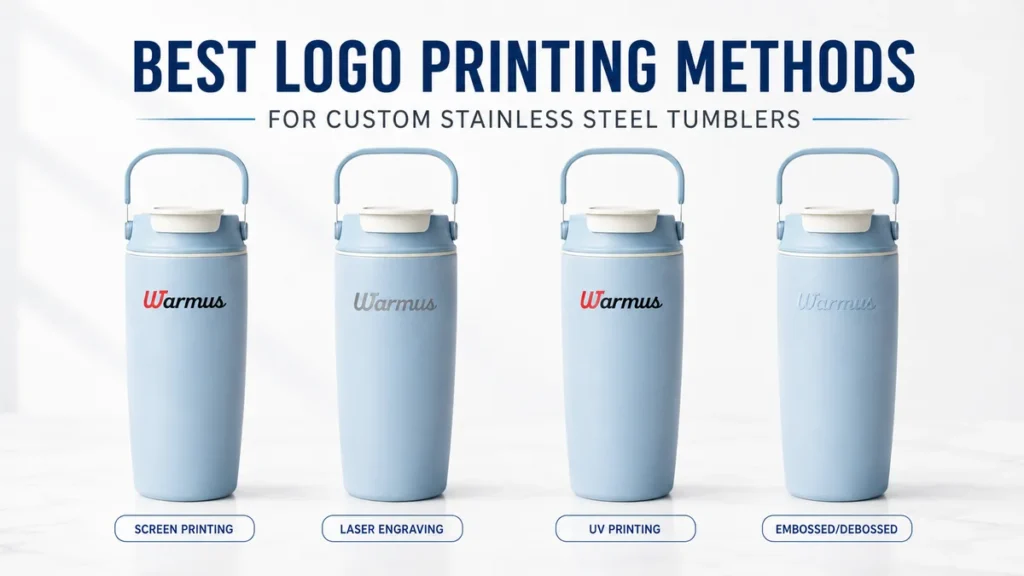
Choosing the best logo printing methods for custom stainless steel tumblers depends on your artwork, order quantity, printing area, durability requirements and budget. A logo is one of the most important elements of a custom stainless steel tumbler. It helps customers recognize your brand, increases the perceived value of the product, and turns an ordinary tumbler into a promotional, corporate gift, or retail-ready item.
However, not every logo printing method is suitable for every design.
The best decoration method depends on several factors, including the number of colors, printing area, order quantity, tumbler coating, required durability, and target budget.
In this guide, we compare the most common logo printing methods for custom stainless steel tumblers and explain how to choose the right option for your project.
1. Screen Printing
Screen printing, also known as silk screen printing, is one of the most widely used decoration methods for stainless steel tumblers and water bottles.
During production, ink is transferred through a prepared screen onto the surface of the tumbler. Each color normally requires a separate screen and printing process.
Screen printing process for custom stainless steel tumblers at Warmus.
Advantages of Screen Printing
Screen printing offers several benefits:
- Relatively low printing cost
- High production efficiency
- Good color coverage
- Suitable for medium and large orders
- Good adhesion when the correct ink and curing process are used
- Suitable for simple logos, text, and basic graphics
Screen printing is especially suitable for one-color logos. It is commonly used for company names, simple brand marks, event logos, and promotional products.
Limitations of Screen Printing
Screen printing is not ideal for every design.
It may not be the best option for:
- Photographic images
- Complex gradients
- Designs containing many colors
- Very fine details
- Extra-large wraparound graphics
- Artwork requiring precise color transitions
Because each color usually requires a separate screen, the production cost and complexity increase when more colors are added.
The shape of the tumbler can also affect the available printing area. Straight-sided tumblers are normally easier to print than products with strong curves, handles, or irregular surfaces.
Best For
Screen printing is recommended for buyers who need a simple, cost-effective logo on a medium or large quantity of stainless steel tumblers.
2. Laser Engraving
Laser engraving uses a laser beam to remove part of the coating or mark the stainless steel surface directly.
On a powder-coated tumbler, the laser normally removes the coating and exposes the stainless steel underneath. This creates a clean metallic logo without using printing ink.
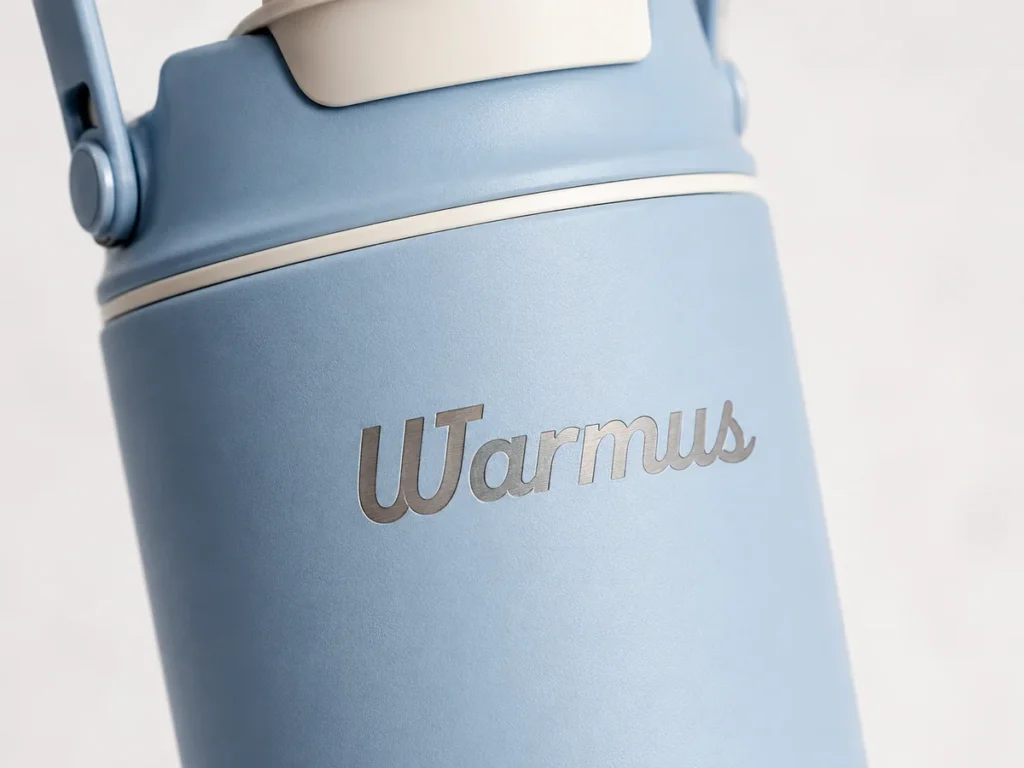
Advantages of Laser Engraving
Laser engraving is popular because it offers:
- Excellent durability
- No ink or printed film
- A clean and professional appearance
- High accuracy for text and fine lines
- Good resistance to scratching and repeated handling
- No risk of printed colors fading during normal use
Laser engraving is frequently used for premium corporate gifts, outdoor products, minimalist drinkware, and high-end retail collections.
Limitations of Laser Engraving
Laser engraving normally produces a metallic or monochrome result. It cannot reproduce full-color artwork in the same way as UV printing or heat transfer printing.
The final appearance also depends on the tumbler material and surface coating. On most powder-coated stainless steel tumblers, the engraved area shows the natural stainless steel color.
Some highly detailed artwork may need to be simplified before production to ensure that small lines and text remain clear.
Best For
Laser engraving is ideal for simple, premium-looking logos where long-term durability is more important than multiple colors.
3. Heat Transfer Printing
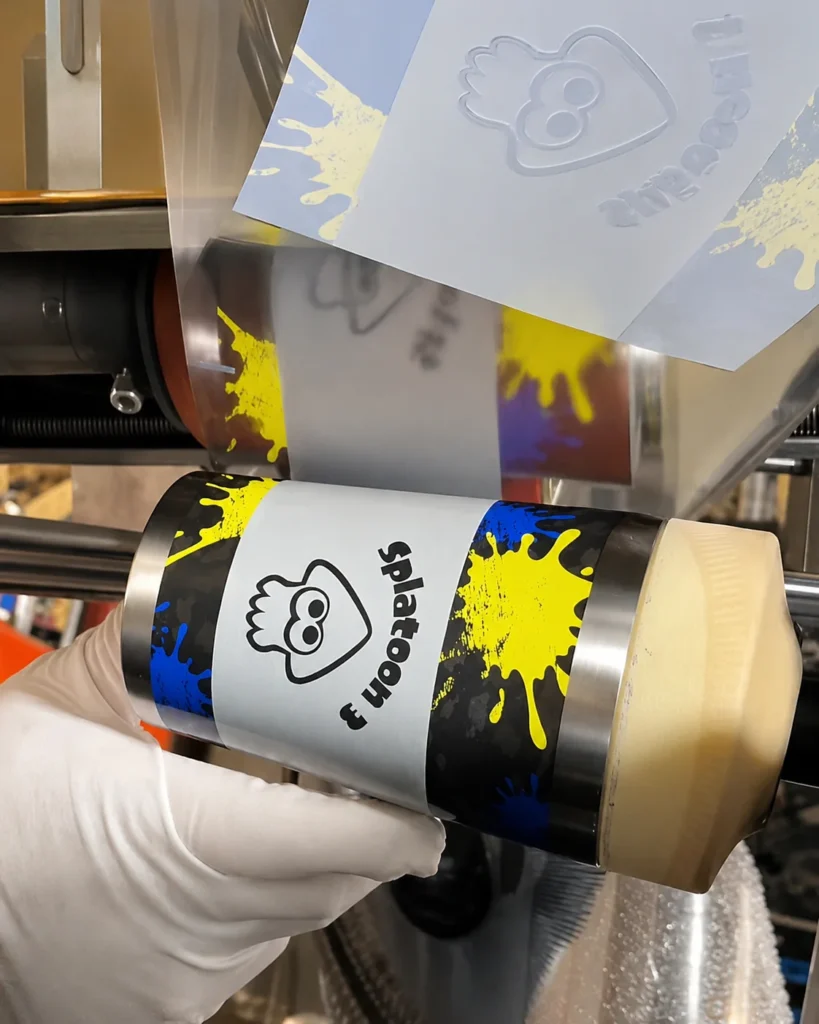
Heat transfer printing uses heat and pressure to transfer a pre-printed design from specially prepared transfer film or paper onto the tumbler surface.
This method is suitable for colorful graphics, gradients, detailed illustrations, and designs covering a relatively large area of the tumbler body.
Advantages of Heat Transfer Printing
Heat transfer printing can provide:
- Full-color printing
- Smooth color transitions and gradients
- Detailed graphics and illustrations
- Larger printing areas
- Better reproduction of complex artwork
- More design flexibility than traditional screen printing
It is commonly used for lifestyle graphics, seasonal collections, sports themes, licensed artwork, and designs that wrap around a large part of the tumbler.
Limitations of Heat Transfer Printing
Heat transfer printing requires customized transfer film or paper to be prepared before production.
The initial transfer film preparation and production setup cost can be relatively high, especially for small orders. This means that the unit decoration cost may be less competitive when only a limited quantity is ordered.
However, the initial film and setup costs can be distributed across more units when the order quantity increases. Therefore, heat transfer printing is generally more cost-effective for large-volume orders or repeat orders using the same artwork.
The final printing result can also be affected by:
- Tumbler shape and curvature
- Printing area
- Surface coating
- Artwork dimensions
- Transfer temperature and pressure
- Production setup
Straight tumbler bodies are normally easier to decorate than products with strong curves, handles, or irregular surfaces.
Buyers should also confirm the required abrasion resistance, washing conditions, and color expectations before mass production.
Best For
Heat transfer printing is suitable for colorful, detailed, or large-area designs that cannot be produced effectively through screen printing.
It is particularly suitable for larger orders because the initial transfer film and setup costs can be shared across a higher production quantity, reducing the average decoration cost per tumbler.
4. UV Printing
UV printing applies ink directly to the product surface and cures it immediately using ultraviolet light.
It can reproduce detailed, colorful artwork and is often selected for logos that require a stronger visual impact.
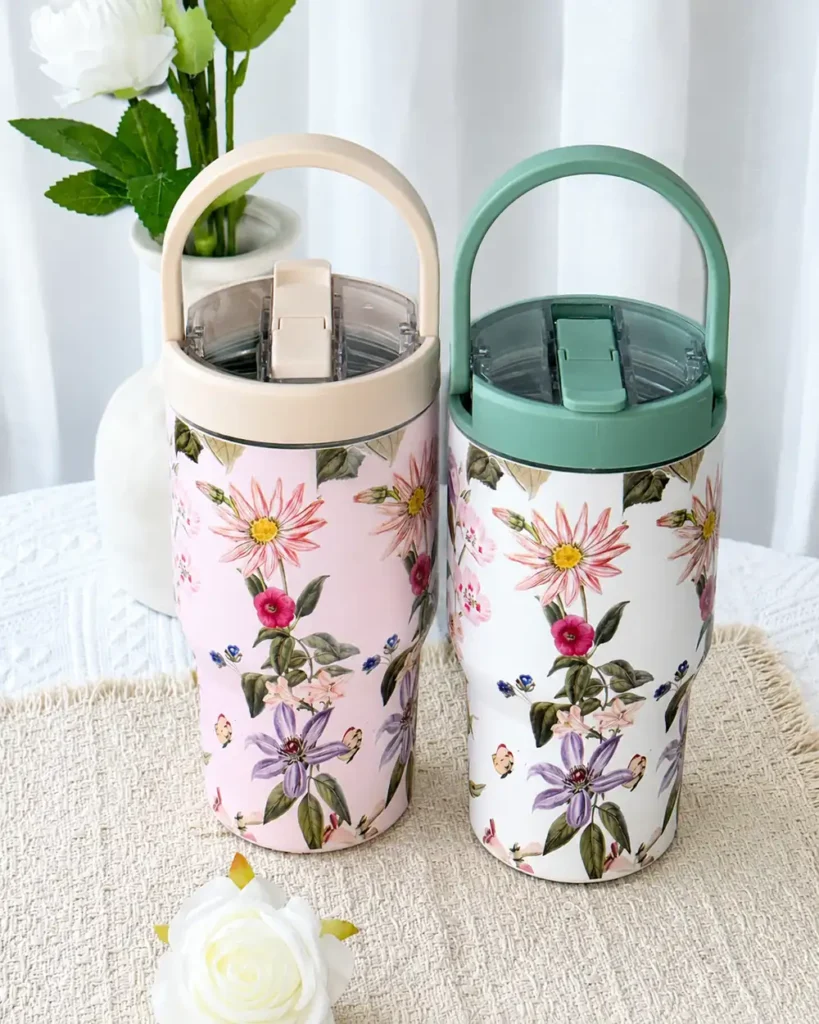
Advantages of UV Printing
UV printing offers:
- Full-color printing
- Fine details
- Sharp text and small graphics
- Gradient effects
- Flexible logo placement
- Good flexibility for smaller customized projects
- Optional raised or textured effects for certain designs
UV printing is useful when buyers want a complex logo without producing a separate printing screen for every color.
It can also be suitable for customized projects involving several logo colors, detailed illustrations, or smaller production quantities.
Limitations of UV Printing
UV printing usually costs more than basic one-color screen printing.
Its durability depends on several factors, including:
- Ink quality
- Surface preparation
- Coating condition
- Curing process
- Logo position
- End-use environment
For products that will experience heavy friction, frequent dishwasher cleaning, or outdoor use, the manufacturer should evaluate the artwork and durability requirements before confirming the method.
A pre-production sample may also be necessary to confirm the adhesion and final appearance.
Best For
UV printing is suitable for detailed, multicolor logos, smaller customized orders, and designs requiring strong visual presentation.
5. Water Transfer Printing
Water transfer printing, also known as hydrographic printing, is mainly used to apply decorative patterns over a larger surface area.
The printed film is placed on water, activated, and transferred onto the tumbler surface.
Advantages of Water Transfer Printing
Water transfer printing is suitable for:
- Wood grain patterns
- Marble effects
- Camouflage designs
- Carbon fiber patterns
- Abstract artwork
- Large-area decorative finishes
Compared with standard logo printing, water transfer printing is more commonly used as an overall surface decoration method.
It can help brands create a distinctive product appearance that is difficult to achieve through ordinary screen printing or laser engraving.
Limitations of Water Transfer Printing
The production process is more complicated than ordinary screen printing and normally requires additional coating and protective finishing.
The final color, pattern position, and overall appearance may vary slightly due to the transfer process.
Color consistency and pattern placement should therefore be confirmed through samples before mass production.
Best For
Water transfer printing is recommended for brands that want a distinctive all-over surface pattern rather than a small standalone logo.
6. 3D Printing and Raised Logos
Some brands prefer a logo with a raised, textured, or three-dimensional effect.
Depending on the design and product surface, this effect may be created through raised UV printing, silicone badges, metal labels, rubber labels, or other decorative components.
Advantages of Raised Logos
A raised logo can:
- Create a stronger visual identity
- Add a tactile effect
- Improve premium product positioning
- Help the product stand out on retail shelves
- Support more creative branding concepts
Raised logos are often used on lifestyle drinkware, premium retail collections, promotional gifts, and products with a strong brand identity.
Limitations of Raised Logos
Raised logo methods are normally more expensive than standard screen printing.
The manufacturer must evaluate:
- Logo height
- Logo size
- Adhesion
- Surface curvature
- Washing conditions
- Packaging protection
- Order quantity
A raised logo may also require additional sampling and testing before mass production.
If the raised decoration projects significantly from the tumbler surface, the packaging may need to be adjusted to prevent scratching, compression, or damage during transportation.
Best For
Raised logo decoration is suitable for premium collections, gift products, and brands that want a more recognizable visual and tactile design.
7. Embossed and Debossed Logos
Embossing creates a raised logo, while debossing presses the design into the product surface.
For stainless steel tumblers, these effects may involve tooling, molds, metal components, silicone parts, or changes to the product structure, depending on the design.
Advantages of Embossed and Debossed Logos
Embossed and debossed logos can provide:
- A permanent branding effect
- A clean appearance without printed ink
- Strong premium positioning
- A distinctive customized product design
- Good long-term brand recognition
Limitations of Embossed and Debossed Logos
This option is normally more suitable for larger orders because it may require tooling, mold changes, or additional product development costs.
It is also less flexible than printing when buyers frequently change their logo artwork.
The manufacturer needs to evaluate whether the selected tumbler structure can support the required embossed or debossed effect.
Best For
Embossed or debossed logos are best for established brands planning larger production quantities and long-term use of the same design.
Comparison of Stainless Steel Tumbler Logo Methods
| Printing Method | Best For | Colors | Cost Level | Durability |
| Screen printing | Simple logos and medium or large orders | Usually 1–3 colors | Low | Good |
| Laser engraving | Premium and durable branding | Monochrome | Low to medium | Excellent |
| Heat transfer printing | Large, colorful graphics and higher-volume orders | Full color | Medium; more economical at larger quantities | Good |
| UV printing | Detailed and multicolor logos | Full color | Medium to high | Good |
| Water transfer printing | All-over decorative patterns | Full color | Medium to high | Good |
| Raised or 3D logo | Premium visual and tactile effects | Multiple options | High | Depends on method |
| Embossed or debossed logo | Permanent custom branding | No printed color required | High | Excellent |
Actual cost and durability depend on the product design, order quantity, surface coating, logo size, artwork, and production requirements.
How to Choose the Right Logo Printing Method
Before selecting a printing process, buyers should consider the following questions.
How Many Colors Are in the Design?
A one-color logo is usually suitable for screen printing or laser engraving.
A full-color design with gradients, illustrations, or color transitions may require UV printing or heat transfer printing.
For a logo containing two or three solid colors, screen printing may still be possible, but each color normally requires a separate screen and printing step.
How Large Is the Printing Area?
A small front logo can be produced using most decoration methods.
A wraparound design or large graphic may require heat transfer printing, water transfer printing, or another large-area decoration process.
The tumbler shape should also be considered. Strong curves, handles, and uneven surfaces may reduce the available printing area or limit the suitable decoration methods.
What Is the Order Quantity?
Order quantity can also affect the most suitable decoration method. Buyers can learn more about how customization affects custom tumbler MOQ.
Screen printing becomes more cost-effective when the order quantity increases because the screen setup cost can be distributed across more units.
Heat transfer printing also becomes more economical at larger quantities because customized transfer film or paper must be prepared before production. The initial film preparation and setup costs have a greater impact on small orders but can be divided across more units in a large-volume order.
UV printing may offer greater flexibility for smaller projects involving complex, multicolor designs.
What Level of Durability Is Required?
Laser engraving is normally one of the most durable choices because the logo is not created with surface ink.
For printed logos, durability depends on the ink, curing process, tumbler coating, logo position, and intended cleaning method.
Buyers should tell the manufacturer whether the product will be frequently washed, used outdoors, placed in a dishwasher, or exposed to heavy friction.
What Is the Target Budget?
For a simple logo and a controlled budget, screen printing is often the most economical option.
For premium positioning or complex artwork, laser engraving, UV printing, or heat transfer printing may provide a better final result.
Buyers should evaluate both the initial setup cost and the unit decoration cost. A method with a higher setup cost may become more economical when the order quantity is large enough.
What Is the Desired Brand Positioning?
A promotional tumbler with a simple company logo may only require screen printing.
A premium gift product may be better suited to laser engraving, a raised logo, or an embossed decoration.
A lifestyle or licensed product featuring colorful illustrations may require UV printing or heat transfer printing.
The decoration method should match the product positioning, target market, and expected retail price.
What Information Should You Send to the Manufacturer?
To receive an accurate recommendation and quotation, buyers should provide:
- Logo artwork in AI, PDF, EPS, or another vector format
- Required logo size
- Printing position
- Pantone color references
- Tumbler model and capacity
- Tumbler body color
- Estimated order quantity
- Required packaging
- Expected washing and durability requirements
- Reference images showing the desired effect
A clear artwork file is especially important for small text, fine lines, and multicolor designs.
For heat transfer printing, buyers should also provide the complete artwork dimensions and confirm whether the design needs to cover only one side or wrap around a larger part of the tumbler.
You can also explore our customization options for logo printing, colors, surface finishes, and packaging.
Is a Sample Necessary Before Mass Production?
A pre-production sample is strongly recommended for custom logo projects.
The sample helps confirm:
- Logo size
- Logo position
- Color accuracy
- Printing clarity
- Surface adhesion
- Overall appearance
- Compatibility with the tumbler coating
Colors may appear different on a computer screen, printed paper, transfer film, and the actual tumbler surface. A physical sample gives the buyer a more accurate understanding of the final result.
For large-area heat transfer, water transfer, raised logo, or complex UV printing projects, sampling is especially important because the product shape and coating can affect the final appearance.
Sample confirmation is also an important step in a complete OEM and ODM drinkware development process.
Frequently Asked Questions
What Is the Most Durable Logo Method for Stainless Steel Tumblers?
Laser engraving is generally one of the most durable options because it does not rely on printed ink. The laser removes the coating or marks the surface directly.
Embossed and debossed logos can also provide excellent durability, but they may require tooling or changes to the product structure.
What Is the Most Affordable Logo Printing Method?
For a simple one-color logo and a suitable production quantity, screen printing is normally one of the most cost-effective options.
The final cost depends on the number of colors, logo size, order quantity, and printing position.
Can Screen Printing Produce a Multicolor Logo?
Yes, but every color normally requires a separate screen and printing step.
As the number of colors increases, production becomes more complicated and the printing cost increases. For logos with many colors or gradients, UV printing or heat transfer printing may be more suitable.
Why Is Heat Transfer Printing More Expensive for Small Orders?
Heat transfer printing requires customized transfer film or paper to be prepared before production.
The initial film preparation and setup costs are relatively high and must be shared across the total order quantity. For a small order, these costs have a greater impact on the price of each tumbler.
For larger orders, the same setup cost can be distributed across more units, making the average decoration cost more competitive.
Is Heat Transfer Printing Suitable for Large Orders?
Yes. Heat transfer printing is particularly suitable for large orders involving colorful, detailed, or large-area artwork.
Because the initial transfer film and production setup costs can be shared across more units, larger orders are generally more cost-effective.
Can a Logo Be Printed Around the Entire Tumbler?
Yes, depending on the tumbler shape and artwork.
Heat transfer printing, water transfer printing, and certain other decoration processes can be used for larger or wraparound designs.
However, handles, strong curves, tapered bodies, and irregular surfaces may limit the available printing area.
Can Laser Engraving Produce a Colored Logo?
Standard laser engraving usually produces a metallic or monochrome result. It is not normally used for full-color graphics.
The exact engraved appearance depends on the material and coating of the tumbler.
Is UV Printing Suitable for Dishwasher Use?
The durability of UV printing depends on the ink, surface coating, curing process, and washing conditions.
Buyers who require dishwasher resistance should clearly inform the manufacturer before sampling and production. Testing may be necessary to confirm whether the selected decoration method meets the required washing conditions.
Which Artwork Format Is Best?
Vector files such as AI, EPS, and editable PDF files are preferred because they allow the manufacturer to adjust the logo size without reducing image quality.
High-resolution image files may sometimes be accepted for full-color artwork, but the manufacturer should review the file before production.
Final Thoughts
There is no single logo printing method that is best for every stainless steel tumbler project.
Screen printing is suitable for simple, cost-effective logos. Laser engraving offers a clean and highly durable result. Heat transfer and UV printing are better choices for colorful or complicated artwork, while water transfer printing is suitable for large decorative patterns.
For heat transfer printing, buyers should consider both the initial transfer film cost and the total order quantity. Because customized film or paper must be prepared before production, the setup cost is relatively high. Larger orders are therefore usually more economical because the initial cost can be shared across more tumblers.
The right decoration method depends on your artwork, order quantity, target price, product surface, brand positioning, and durability requirements.
Warmus provides OEM and ODM manufacturing services for custom stainless steel tumblers, water bottles, travel mugs, and other drinkware products.
Our team can evaluate your logo artwork and recommend a suitable decoration method based on your design, order quantity, target budget, and production requirements.
To receive a customized recommendation, contact Warmus and send us your selected tumbler model, estimated quantity, logo file, printing size, printing position, and preferred decoration effect.