
When people develop a custom tumbler, a lot of attention goes to the cup body: capacity, stainless steel grade, coating color, logo and packaging.
The lid is sometimes treated as something to decide later.
In practice, it can make or break the product.
A lid affects how the tumbler feels every time the customer uses it. It determines how easy the product is to drink from, whether it can be carried in a bag, how difficult it is to clean, and how many parts need to be assembled and inspected during production.
It can also have a noticeable effect on cost.
That is why different tumbler lid types should be compared by function, not simply by appearance.
A slide lid may work perfectly for an office coffee tumbler but make little sense for a bottle that needs to travel inside a backpack. A straw lid is convenient on a 40 oz tumbler but creates a very different sealing challenge from a screw-on bottle lid.
Below is a practical comparison of the most common options.
Tumbler Lid Types: Quick Comparison
Different tumbler lid types are designed for different drinking habits, sealing requirements and use cases.
| Lid Type | Best Use | Leak Resistance* | Cleaning | Relative Cost |
|---|---|---|---|---|
| Slide Lid | Coffee, office, desk use | Low–Moderate | Easy | Lower |
| Flip Lid | Commuting, one-handed drinking | Moderate | Medium | Medium |
| Straw Lid | Cold drinks, large tumblers | Low–Moderate | Medium | Medium |
| Screw Lid | Travel, outdoor, sports bottles | Higher | Easy–Medium | Medium |
| Dual-purpose Lid | Lifestyle and large-capacity tumblers | Depends on structure | More complex | Higher |
Leak resistance depends on the complete lid structure, gasket, vent, tolerances and fit with the tumbler. These ratings are general comparisons rather than performance guarantees.
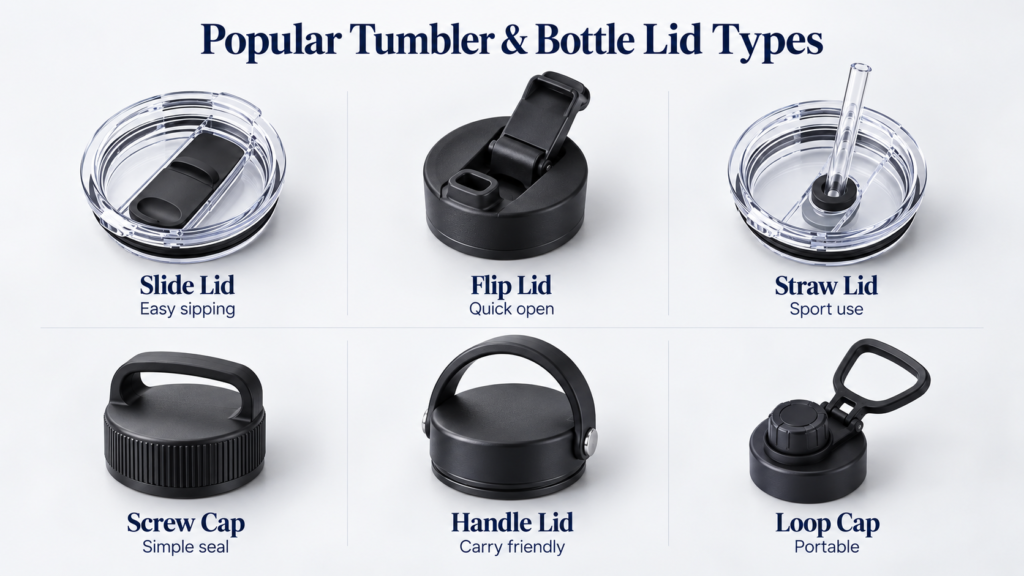
Slide Lids: Simple and Practical
Slide lids are common on coffee tumblers and travel mugs.
The idea is straightforward: slide the cover open to drink, then close it again when the tumbler is sitting on a desk or in a cup holder.
This type of lid works well when convenience matters more than complete sealing.
Typical applications include:
- Office coffee tumblers
- Desk mugs
- Corporate gifts
- Short commutes
- Cup-holder use
One advantage is that the structure can remain relatively simple. Fewer moving parts generally mean easier assembly and easier cleaning.
Are Slide Lids Leakproof?
Many conventional slide lids are better described as spill-resistant rather than fully leakproof.
Closing the slider can reduce splashing during normal upright use, but the drinking opening, vent or slider interface may still allow liquid to escape when the tumbler is tilted or turned upside down.
This distinction matters.
A customer who places a tumbler in a car cup holder has a very different expectation from someone who wants to put it horizontally inside a work bag.
If bag use is part of the product positioning, the lid should be tested specifically for that scenario.
Flip Lids: Convenient for One-Handed Use
Flip lids use a hinged or movable cover over the drinking opening.
They are especially useful when the customer wants to open the tumbler with one hand.
That makes them common for:
- Commuting
- Driving
- Travel
- Sports
- Coffee and tea
Compared with a basic slider, a flip cover can create a more positive closed position. Some designs also use a silicone seal or locking feature.
The trade-off is complexity.
A flip lid may involve a hinge, cover, sealing part and additional connection points. Every extra component creates another tolerance that needs to work correctly during production.
It also creates another place where residue can collect if the lid is difficult to take apart.
A good flip lid should not only close securely. It should also be comfortable to open repeatedly and easy enough for the customer to clean.
Straw Lids: Popular for Large-Capacity Tumblers
Straw lids are now closely associated with large-capacity lifestyle tumblers.
They make sense for a simple reason: lifting and tilting a 30 oz or 40 oz tumbler every time you drink is not always convenient.
A straw allows the user to drink frequently while the tumbler stays upright.
Depending on the design, a straw lid may include:
- Reusable straw
- Straw port
- Silicone seal
- Rotating cover
- Handle
- Separate sip opening
This works particularly well for cold water, iced drinks, fitness and everyday hydration.
The Straw Opening Is Also a Leak Point
The convenience of a straw opening comes with a trade-off.
It creates another path through which liquid can escape.
A lid can have an excellent seal around the outside edge and still leak through the straw opening when the tumbler is tilted.
For that reason, a large tumbler with an exposed straw should not automatically be marketed as suitable for carrying horizontally in a bag.
If stronger sealing is required, the straw opening itself needs an effective closing structure.
Screw-on Lids: Better for Stronger Sealing
Screw lids use threads to connect the lid to the bottle or tumbler body.
When the thread, gasket and contact surfaces are properly designed, this structure can provide stronger sealing than many simple press-fit or slide lids.
That makes screw lids common for:
- Sports bottles
- Outdoor bottles
- Travel bottles
- Products carried in bags
- Products where leak resistance is a priority
The trade-off is speed.
A screw lid is normally slower to open than a slide lid.
That may not matter on a hiking bottle, but it can matter on a coffee tumbler used constantly at a desk.
There is no reason for every tumbler to use the strongest possible seal. The lid should match the way the product will actually be used.
Dual-purpose and Rotating Lids
Some newer large-capacity tumblers combine several drinking modes in one lid.
For example:
Straw opening → direct-sip opening → closed position
This gives the user more flexibility and can make the product feel more feature-rich.
It also gives the manufacturer more things to control.
A multi-function lid may require careful management of:
- Rotating fit
- Opening alignment
- Silicone seals
- Component tolerances
- Assembly
- Straw position
- User operation
This is a good example of why “more functions” does not always mean “better product.”
If the mechanism feels loose, is difficult to clean or becomes confusing to operate, the extra feature adds complexity without improving the user experience.
For retail brands, a dual-purpose lid can be a strong selling point. But it should earn its place in the design.
Leakproof and Spill-resistant Are Not the Same Thing
These two terms are often used too casually.
A spill-resistant lid is mainly intended to reduce splashing or accidental spills during normal upright use.
A lid intended for stronger leak resistance needs tighter control over all possible escape paths.
Those paths may include:
- Drinking opening
- Straw port
- Air vent
- Silicone gasket
- Thread
- Slider
- Rotating mechanism
- Connections between plastic parts
A lid can look completely closed and still contain a vent.
This is why visual inspection alone tells very little about leak performance.
The intended claim should match the test.
A coffee tumbler that stays upright in a cup holder does not need to be tested in exactly the same way as a bottle that is expected to travel inside a backpack.
The Silicone Gasket Is Small, but Critical
A lot of lid problems come down to one small component: the silicone gasket.
Its job is to maintain sealing pressure between surfaces.
Problems can appear when a gasket is:
- Missing
- Twisted
- Installed in the wrong direction
- Damaged
- Deformed
- Too loose
- Too tight
- Poorly matched to the groove
A lid can be well designed and still fail if the gasket is assembled incorrectly.
For this reason, gasket fit should be checked during both sampling and mass production.
It is also worth asking whether the customer can remove and reinstall the gasket easily. A seal that works perfectly at the factory but becomes difficult to reinstall after cleaning may create complaints later.
PP vs Clear Copolyester Lid Components
PP is widely used for tumbler lids, particularly for opaque structural components.
It works well for many injection-molded parts and is common across drinkware products.
Clear copolyester materials, including Tritan in applicable designs, may be selected when transparency and visual appearance are important.
A clear lid can make a retail tumbler look more refined, but appearance should not be the only consideration.
Material choice also depends on:
- Component shape
- Wall thickness
- Mechanical load
- Assembly method
- Target price
- Product positioning
A higher-cost material does not compensate for a poorly designed lid.
The structure still matters more.
Cleaning Is Often Overlooked During Product Development
A lid can look excellent in a rendering and still become frustrating after several weeks of use.
The reason is usually cleaning.
Complex lids can contain:
- Narrow channels
- Hidden corners
- Straw connections
- Small silicone parts
- Hinges
- Rotating components
These areas can retain water, coffee or other beverage residue.
When reviewing a lid sample, one useful question is:
Can a normal customer take this apart, clean it and put it back together without instructions?
If the answer is no, that does not automatically make the design bad. But the added complexity should be justified.
For everyday products, simpler often works better.
Beverage Type Also Matters
Lid choice should also follow the drink.
Slide and flip openings are common for coffee and tea because they allow controlled sipping.
Straw and dual-purpose lids are more common on large-capacity cold-drink tumblers, where frequent hydration is the main use case.
For outdoor or travel bottles where sealing is more important, screw-on or otherwise strongly sealed structures are often more suitable.
The right lid is not simply the most popular lid on the market. It is the one that matches the product’s intended use.
Can One Lid Fit Different Tumblers?
Sometimes.
But similar-looking openings do not guarantee compatibility.
A lid can be affected by:
- Mouth diameter
- Thread specification
- Rim profile
- Lid depth
- Gasket position
- Press-fit tolerance
- Handle clearance
- Straw length
Even a small difference in the rim can change the way a gasket seals.
This is especially important in OEM projects.
If a brand wants to move a lid from one tumbler body to another, the fit should be confirmed with real samples or engineering dimensions rather than assumed from appearance.
On many existing tumbler models, the lid and cup mouth were developed as a matching system. A different lid may require more than simply finding the same nominal diameter.
Existing Lid or Custom Lid?
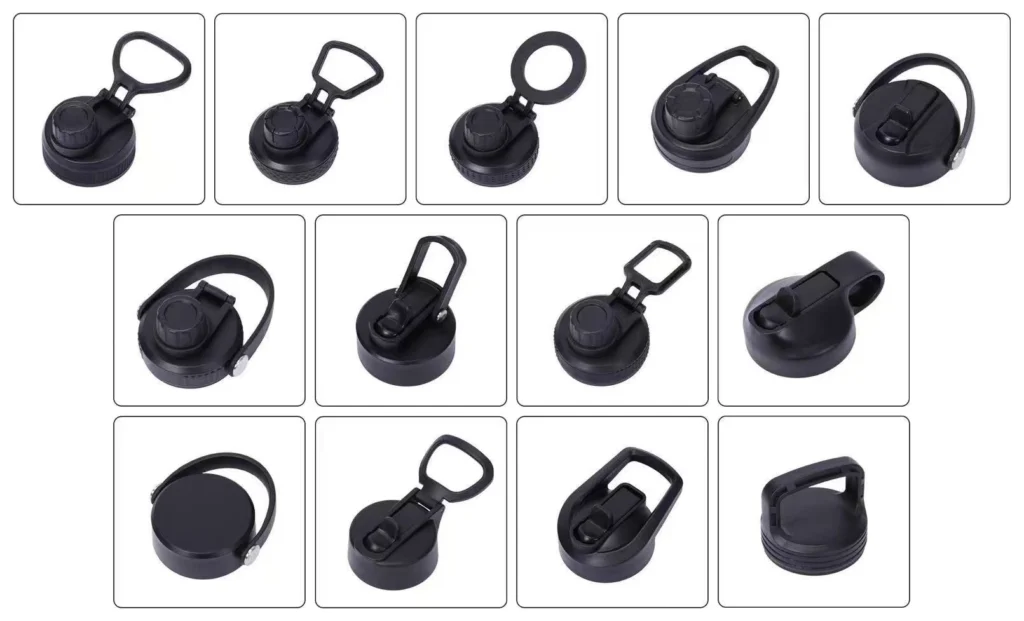
For most private-label projects, using an existing compatible lid is the fastest place to start.
Existing Lid
Advantages usually include:
- No new lid mold
- Lower development cost
- Faster sampling
- Shorter lead time
- Existing production experience
- Easier cost control
If the lid already delivers the drinking experience the brand wants, there may be little reason to redesign it.
Custom Lid
A custom lid becomes more interesting when the brand needs something genuinely different, such as:
- Unique functionality
- Proprietary appearance
- Special locking system
- Different drinking mode
- Strong product differentiation
A completely new lid can require:
- Design work
- Engineering
- Mold development
- Trial molding
- Sample revisions
- Functional testing
- Leak testing
For small projects, this development cost may not make commercial sense.
For a large program or a product intended to remain in the market for several years, it may be easier to justify.
How Lid Choice Affects Tumbler Cost
Two tumblers can use almost the same stainless steel body and still have noticeably different prices because of the lid.
A more complicated lid may require:
- More plastic material
- More injection-molded components
- Silicone seals
- Straw parts
- Additional assembly
- More inspection
- More complicated tooling
The cost difference becomes even more significant if a new mold is required.
This is why the lid specification should be confirmed before comparing supplier quotations.
For a broader breakdown of pricing factors, see:
Custom Stainless Steel Tumbler Cost: What Affects the Final Price?
Lid Design Can Change the Packaging Too
The lid does not only affect the tumbler itself.
A tall straw, large handle or protruding flip mechanism can change the overall dimensions of the finished product.
That may affect:
- Individual box size
- Packaging insert
- Pieces per carton
- Master carton dimensions
- CBM
- Freight cost
Extra straws or replacement lid components also need space inside the package.
For larger orders, a small dimensional change can become significant once it is multiplied across hundreds of cartons.
So the lid, tumbler body and packaging should ideally be evaluated together.
For more detail on packaging structure, carton size, CBM and shipping considerations, see our guide Custom Tumbler Packaging Options for Retail and E-commerce.
What Should Buyers Test on a Tumbler Lid Sample?
A lid sample should be tested with the actual tumbler body, not only inspected on its own.
Here are the checks that matter most.
Opening and Closing
Operate the slider, flip part, rotating mechanism or lock repeatedly.
The movement should feel consistent. It should not become noticeably looser or harder to operate after repeated use.
Gasket Fit
Check that the silicone gasket sits correctly in its groove.
Remove it and reinstall it once.
If it is difficult to put back correctly, customers may encounter the same problem after cleaning.
Leak or Spill Performance
Test the product according to how it will actually be sold.
A desk coffee tumbler and a sealed travel bottle should not be judged against the same expectation.
For a lid intended to resist leaking, test different orientations rather than only leaving the product upright.
Drinking Flow
A good seal is not enough if the product is uncomfortable to drink from.
Check whether the liquid flow is smooth and whether the vent works properly.
Poor venting can cause uneven flow, splashing or an uncomfortable drinking experience.
Cleaning and Reassembly
Take apart the removable components.
Clean them.
Then put everything back together.
If the process is unnecessarily difficult during sampling, it will probably also be difficult for the end customer.
Fit With the Final Tumbler
Check:
- Thread engagement
- Press fit
- Gasket compression
- Lid depth
- Handle clearance
- Straw length
Do this using the actual final cup body whenever possible.
Lid Quality Control During Mass Production
Sampling proves that a design can work.
Mass production needs to prove that it can work repeatedly.
Inspection priorities depend on the lid type.
Slide Lid
Check slider fit, opening force and movement.
Flip Lid
Check hinge movement, closure and seal position.
Straw Lid
Check straw fit, straw opening and sealing components.
Screw Lid
Check thread engagement and gasket compression.
Dual-purpose Lid
Check every operating position, not only the most commonly used one.
For all lid types, appearance should also be checked for molding defects, deformation and incorrect assembly.
The lid is one of the parts customers touch most often, so small defects are easy to notice.
Which Tumbler Lid Type Should You Choose?
| Product Requirement | Recommended Starting Point |
|---|---|
| Office coffee tumbler | Slide lid |
| One-handed commuting | Flip lid |
| 30–40 oz lifestyle tumbler | Straw or dual-purpose lid |
| Stronger leak resistance | Screw lid |
| Outdoor bottle | Screw or chug-style lid |
| Multi-use retail product | Dual-purpose / rotating lid |
| Easy cleaning | Simpler removable structure |
| Lower development cost | Existing compatible lid |
| Unique branded product | Custom lid if volume supports tooling |
These are starting points, not fixed rules.
There is no single best tumbler lid.
The right choice depends on the beverage, sealing requirement, drinking experience, cleaning expectations, target price and whether the project can support new tooling.
FAQ
Are Slide Tumbler Lids Leakproof?
Many conventional slide lids are better treated as spill-resistant rather than fully leakproof. Liquid may still escape through the drinking opening, vent or slider area when the tumbler is tilted or inverted.
Which Lid Is Best for Coffee?
Slide and flip lids are common choices because they allow controlled sipping and convenient opening.
The final choice depends on whether the product prioritizes quick access, stronger closure or easy cleaning.
Which Lid Is Best for a 40 oz Tumbler?
Straw and dual-purpose lids are common on large-capacity tumblers because they allow frequent drinking without requiring the user to lift and tilt the entire cup.
Which Lid Is Better for Strong Leak Resistance?
A properly designed screw-on lid with an appropriate gasket is often a stronger starting point when sealing is the main requirement.
Actual performance still depends on the complete design and fit.
Can One Lid Fit Several Tumbler Sizes?
Sometimes, but compatibility depends on more than the nominal opening diameter.
The mouth profile, thread, gasket position, lid depth and other dimensions must also match.
Why Does a Tumbler Lid Leak?
Common causes include incorrect gasket installation, damaged seals, vents, straw openings, poor component fit, thread issues or manufacturing tolerance problems.
Does a Custom Lid Need a New Mold?
A completely new lid structure normally requires new tooling.
If an existing compatible lid can meet the functional requirements, using it can reduce development cost and shorten the project timeline.
Final Thoughts
Different tumbler lid types create very different user experiences, especially in sealing, cleaning, drinking comfort and portability.
The lid affects drinking comfort, sealing, cleaning, portability, manufacturing complexity, packaging and cost.
For OEM and private-label projects, lid selection should therefore happen together with the tumbler body rather than at the very end of product development.
At Warmus, different tumbler models are available with slide, flip, straw, screw and dual-drink lid structures. In many projects, using an existing compatible lid is the fastest and most cost-efficient starting point.
When a project requires a completely new lid, the decision should also consider design work, tooling, sampling, testing, MOQ and development time.
If you are developing a tumbler project, you can share the product style, capacity, expected quantity, target market and required lid function with us.
We can help evaluate whether an existing lid is suitable or whether a custom lid structure should be developed.